
Key takeaways: Maximize savings with Dependent Care FSAs
- A Dependent Care Flexible Spending Account (DCFSA) lets employees set aside pre-tax dollars to cover eligible dependent care costs, including childcare, preschool, summer day camp, and elder care.
- Eligible dependents include children under 13, adult dependents who cannot care for themselves, and spouses who are physically or mentally unable to self-care.
- Annual contribution limits are set by the IRS and vary based on filing status.
- DCFSAs can boost employee satisfaction, improve retention, and help caregivers stay in the workforce despite rising care costs.
Paying for dependent care is a source of stress for many employees and their families. A report from the Economic Policy Institute1 found that childcare costs more than public college tuition in 38 states and more than rent in 17 states. The statistics are also eye-opening when it comes to elder care. According to an AARP report,2 just over one-third of family caregivers say they have had to stop saving in order to pay for care, and 18% say it is a significant financial strain for them.
Employers are on the forefront of helping their people find relief from rising care costs. One key tool? Dependent Care Flexible Spending Accounts (DCFSAs). This benefit allows employees to save pre-tax dollars for expenses like preschool, child or elder daycare, and more.
In this article, we will break down the details of DCFSAs and explore how they can relieve the stress of dependent care costs for employees and their families.
What is a dependent care flexible spending account (DCFSA)?
A DCFSA is a pre-tax benefit account used to pay for eligible dependent care services, such as daycare, preschool, summer day camp, before or after school programs, and/or elder care.
Here is how it works:
- Employees choose a yearly contribution amount, up to annual federal limits.
- Payroll sets aside pre-tax funds automatically each pay period.
- Employees use the account to cover eligible care costs so they can continue working.
- Employers can tailor plan features, including waiting periods, employer contributions, and grace periods.
Employers have flexibility in how they set up DCFSA accounts for employees, and the rules and contributions can be tailored to meet employers' specific needs and desires.
Who is a dependent?
Employees can generally use DCFSA funds for care tied to these dependents:
- Children under age 13
- Children age 13 or older who cannot care for themselves due to a mental or physical disability
- A spouse who cannot care for themselves due to a mental or physical disability
- Parents or other adults the employee can claim as dependents who cannot care for themselves
In most cases, the dependent must live with the employee for more than half the year, and the employee must provide more than half of their financial support. This includes both dependent children and older adults.
If you want to help employees self-screen quickly, consider sharing a simple checklist during open enrollment: who qualifies, residency and support basics, and a reminder to confirm details with a tax advisor when they are unsure.
What expenses are DCFSA-eligible?
The Internal Revenue Service (IRS) sets what counts as an eligible dependent care expense. Many plans cover things like daycare and preschool, while disallowing expenses that do not directly enable the employee (and spouse, if applicable) to work or look for work.
You can search HealthEquity's eligible expenses list here, which gives examples and explanations of what is covered and what is not.
Take a look at some common examples of eligible and ineligible expenses:
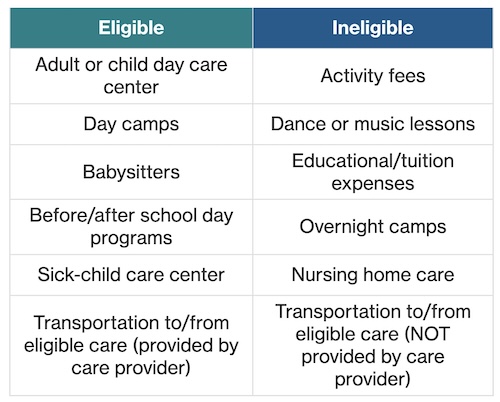
Please keep in mind that this list is not comprehensive; it shows some of the most common expenses, but employees should check with a tax professional when planning their DCFSA spending and reimbursement.
Employees typically get reimbursed in three simple steps:
- Pay out of pocket for eligible dependent care.
- Submit receipts and any required details to the plan administrator.
- Choose reimbursement by check or direct deposit into a bank account.
A quick note: to utilize a DCFSA, employees (and their spouse if filing jointly) must have earned income during the year, meaning they are working or actively looking for work, as defined by the IRS. A spouse is considered to have earned income for DCFSA purposes if they are either a full-time student for at least five calendar months during the tax year, or physically or mentally incapable of self-care and lived with the employee for more than half the year.
Full-time caregivers, like stay-at-home parents, cannot be paid for the work they do using DCFSA funds. For example, if an employee has a spouse who is a stay-at-home parent, they cannot use DCFSA funds to pay that spouse a salary. They can, however, pay a nanny if their spouse is working, looking for work, or attending school.
A practical way to reduce confusion is to point employees to a clear eligible expenses resource and encourage them to keep strong documentation.
What are the maximum yearly DCFSA contribution limits?
The IRS is responsible for determining annual contribution limits for DCFSAs. These can change each year and may be revised due to new legislation. Employers will want to keep up with these changes to satisfy IRS nondiscrimination testing.
Employees can contribute different amounts based on their tax filing status. Married couples filing separately can contribute half the annual limit of married couples filing jointly or individuals filing as head of household.
The One Big Beautiful Bill Act increased contribution amounts for the 2026 tax year, which can help caregivers keep up with increasing costs. Employees should check the latest contribution limits.
If an employee and spouse are both eligible to contribute to a DCFSA, they cannot each contribute the maximum amount; that is the limit for the entire household. Similarly, eligible expenses cannot be reimbursed twice.
Employers can also contribute to DCFSAs on behalf of employees. When planning yearly contributions, employees must take employer contributions into account and not exceed the annual limit.
| Filing status | Earned income limitation for DCFSA purposes |
|---|---|
| Single or head of household | Employee's salary, excluding DCFSA contributions |
| Married | The lesser of the employee's salary, excluding DCFSA contributions, or the spouse's salary |
Employers may choose a different limit for their plans and can also contribute to employee accounts. Employers will need to monitor contribution updates so they can support required IRS nondiscrimination testing and keep plans aligned with current rules.
How do DCFSAs compare to healthcare or Limited Purpose FSAs?
FSA stands for flexible spending account, and there are three types: Healthcare FSAs, Limited Purpose FSAs, and DCFSAs. All three accounts allow employees to make pre-tax contributions, but they are used for different purposes.
Healthcare FSAs cover eligible healthcare expenses, such as over-the-counter medications, diabetic supplies, chiropractic care, sleep aids, and dental and vision costs. Limited Purpose FSAs are more restricted, with eligible expenses including dental exams, eye exams, and related supplies.
Healthcare FSAs are compatible with most health plans, but employees who contribute to one are not eligible for an HSA. IRS rules do allow HSA account holders to use LPFSAs and DCFSAs. This is a smart way to maximize savings and prepare for health, dental, vision, and dependent care costs. Learn all about FSA options here.
Why are DCFSA benefits great for employers and employees?
Dependent care costs create real pressure for working families, and that pressure often shows up at work as stress, missed time, or workforce exits. A DCFSA offers a meaningful way to help employees increase their take-home pay through tax advantages, which can improve their confidence in affording care.
According to a 2025 MetLife study,3 employees who have positive experiences with their benefits are:
- 2.4X more likely to feel holistically healthy
- 1.9X more likely to trust that their organization is on their side
- 1.8X more likely to trust their employer's leadership
DCFSA benefits are one key piece of an employee benefits program that can create positive experiences. If benefits professionals also focus on helping employees understand these benefits, it can even lead to better employee retention. HealthEquity's research found that 97% of employees who are satisfied with the support they get to understand benefits say they’ll stay with their employer for at least 2 years.
It’s also worth mentioning financial wellness. As the cost of childcare outpaces inflation, families struggle to pay for daycare, after school programs, babysitters, and other expenses. For many employees, their entire salary might be eaten up by rising care costs. This could lead to a caregiver dropping out of the workforce entirely.
In fact, one report4 found that 50% of Millennial moms and 52% of Gen Z moms have considered quitting their jobs because the cost and stress of childcare outweigh their earnings. A robust DCFSA can help parents boost take-home pay and feel confident in their ability to pay for dependent care. Here's a handy DCFSA overview guide to share with your employees as they navigate their DCFSA benefits.
For employers, that support can translate into measurable wins:
- Stronger benefits experiences that help build trust
- Better retention when employees feel supported and understand their benefits
- Improved financial wellness momentum, especially for caregivers
If you want to boost impact quickly, promote the DCFSA early, not just during enrollment, and pair it with plain-language guidance on who qualifies, what counts as an eligible expense, and how reimbursement works.
DCFSAs are truly a win-win for employers and their people. Want to learn more about how benefits teams can support caregivers with DCFSAs? Visit our employer guide to DCFSAs.
Frequently Asked Questions about Dependent Care Flexible Spending Accounts
References and Disclosures
1The Economic Policy Institute press release, "Updated resource calculates the cost of child care in every state," March 2025.
2AARP, "Caregiving in the U.S. Research Report," July 2025.
3MetLife, "Tapping into the power and importance of trust," 2025.
4Motherly, "State of Motherhood," 2025.
HealthEquity does not provide legal, tax, or financial advice.
DCFSAs are never taxed at a federal income tax level when used appropriately for eligible dependent care expenses. Most states recognize DCFSA funds as tax deductible with very few exceptions. Please consult a tax advisor regarding your state's specific rules.