
Key takeaways
- The IRS has raised the health Flexible Spending Account (FSA) contribution limit from $3,300 to $3,400 for 2026, with the maximum carryover amount increasing from $660 to $680.
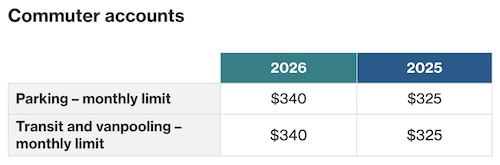
- Commuter benefit limits (both parking and transit) will increase to $340 per month, up from $325 in 2025.
- Open enrollment is your opportunity to communicate these changes so employees can maximize their pre-tax savings.
See up-to-date Flexible Spending Account (FSA) contribution limits here.
It’s that time of year again – the Internal Revenue Service (IRS) has announced new contribution limits for Flexible Spending Accounts (FSAs), commuter benefits, and more. The announcement comes just in time for Open Enrollment season, when employers are preparing benefits education programs and helping employees understand their annual contributions. We’ll share all the upcoming changes, along with some tips for how employers can prep for Open Enrollment.
What are the IRS 2026 FSA contribution limits?
For health FSAs, the IRS increased the annual employee contribution limit from $3,300 to $3,400.
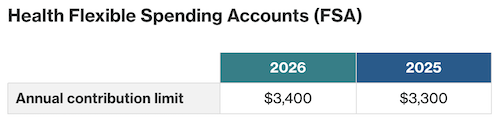
If your plan allows carryover, the maximum carryover amount also increased from $660 to $680.
- Health FSA annual contribution limit (2026): $3,400 (up $100 from $3,300)
- Why it changed: Inflation adjustment
- Common eligible expenses include:
- Copayments
- Deductibles
- Prescriptions
- Over-the-counter medications
- Dental and vision expenses
- FSA carryover maximum (if your plan allows carryover): $680 (up $20 from $660)
Action steps you can take now:
- Update your open enrollment materials to reflect the new $3,400 limit and $680 carryover cap (if your plan offers carryover).
- Remind employees what an FSA can cover – check out our guide to eligible FSA expenses here.
- Reinforce the “use it or lose it” concept in simple terms, and clearly explain your plan’s carryover or grace period rules, if offered.
How did the IRS update commuter benefit contribution limits for 2026?
The IRS increased the monthly limits for both qualified parking and transit benefits to $340 per month, up from $325 in 2025.
Action steps you can take now:
- Confirm your payroll deductions and enrollment portal display the correct $340 monthly maximums.
- Coordinate early with any commuter vendor to avoid last-minute corrections during open enrollment.
What are the maximum amounts for adoption assistance in 2026?
This year, adoptive parents will also see an increase in the maximum credit allowed for 2026. It will jump to $17,670, up from $17,280 in 2025. The amount of credit that may be refundable will be $5,120 in 2026. These updates are important for families planning to adopt, as they provide enhanced financial support through exclusions and credits on their tax obligations.
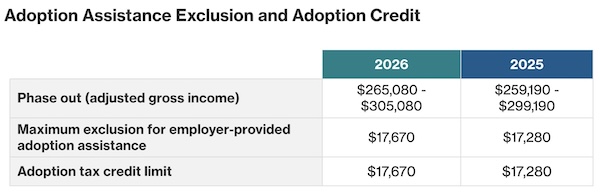
- Maximum adoption credit (2026): $17,670 (up from $17,280 in 2025)
- Refundable amount (2026): $5,120
- Why it matters: Families may be able to exclude more adoption-related expenses from taxable income and claim a larger credit, which can reduce the overall cost of adoption.
Action steps you can take now:
- Update adoption support materials and enrollment portals as needed.
How much can be contributed to a QSEHRA in 2026?
Qualified Small Employer Health Reimbursement Arrangement (QSEHRA) limits will also see small boosts in 2026. These accounts provide a flexible solution for smaller businesses and their employees to pay for health coverage.
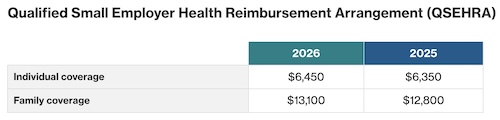
For 2026, QSEHRA limits increased to:
- $6,450 for individual coverage (up $100 from 2025)
- $13,100 for family coverage (up $300 from 2025)
Action steps you can take now:
- Verify your plan documents and employee guides reflect the new annual caps.
- Add a plain-language reminder that QSEHRAs reimburse eligible premiums and qualified medical expenses, subject to plan rules.
What are the 2026 contribution limits for MSAs?
Medical Savings Accounts (MSAs) offer individuals a tax-advantaged way to save for medical expenses, specifically through high-deductible health plans (HDHPs).
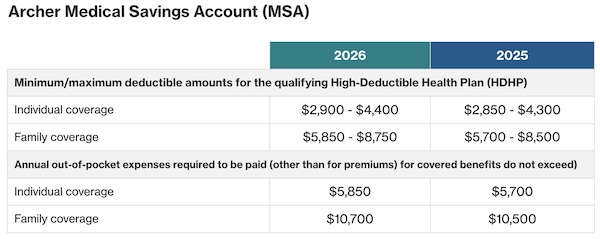
For 2026 MSA-qualified HDHPs, the IRS set:
- Minimum deductible (individual coverage): $2,900
- Maximum deductible (individual coverage): $4,400
Action steps you can take now:
- If your workforce includes MSA participants, include these thresholds in your plan comparison or compliance materials.
- Keep definitions simple so employees understand how an MSA differs from an HSA, when relevant.
What are the 2026 HSA contribution limits?
The IRS announced new contribution limit increases for Health Savings Accounts (HSAs) in May 2025, but it’s still a good idea for employers to double check the information they are sharing with employees during Open Enrollment.
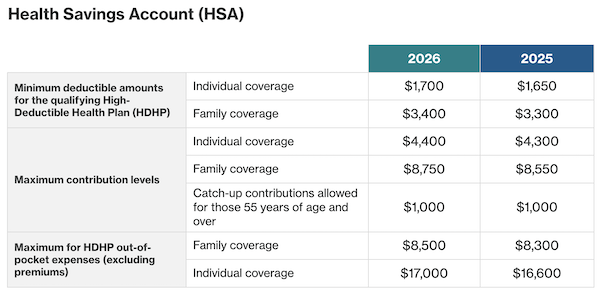
Here are the updated HSA contribution limits for 2026:
- HSA contribution limits: $4,400 (individual) and $8,750 (family)
- HDHP minimum deductibles: $1,700 (individual) and $3,400 (family)
- Out-of-pocket maximums: $8,500 (individual) and $17,000 (family)
Action steps you can take now:
- Double-check every place employees might see these numbers, including benefit guides, intranet pages, FAQs, payroll FAQs, and vendor portals.
- Offer a simple per-paycheck calculator or worksheet so employees can confidently set elections.
Best practices for Open Enrollment
The 2026 IRS updated limits provide a great opportunity for employees and their families. It can help them maximize pre-tax savings, save for critical expenses, and make the most of your benefit offerings. Here are three things employers can do to help get the word out:
- Update your enrollment season materials: Make sure your 2026 benefits booklet, Open Enrollment webinar slides, portal, and all other communication materials reflect these updated contribution limits. Check out our OE Toolkit for help getting started.
- Provide calculators: Make it easy for employees to calculate their contributions from each paycheck with calculators or links to online tools.
- Tell them again (and again): Benefits teams are all too aware that people need to hear information more than just once in order to remember it. Make sure there are lots of opportunities for employees to get familiar with the new IRS limits. HealthEquity’s Content Library is a good place for members to start their benefits education.
All these contributions can really add up for employees and their families. Benefits teams can use Open Enrollment as an opportunity to help employees understand their options, maximize their savings, and make strategic decisions for their families.
Frequently asked questions
References and disclosures
HealthEquity does not provide legal, tax, or financial advice.
Contribution limits are set by the IRS and may vary depending on employer plan design.
Not all plans allow carryover or rollover of funds. Check with your employer for specific plan details.
This content is for informational purposes only and should not be construed as legal, tax, or financial advice.