
Key takeaways:
-
The CARES Act allows Health Savings Account (HSA)-qualified health plans to cover telemedicine before a member meets their deductible, without affecting HSA contribution eligibility.
-
This change makes it easier for HSA holders, including those in rural areas, to access remote care without risking their ability to save for future health costs.
-
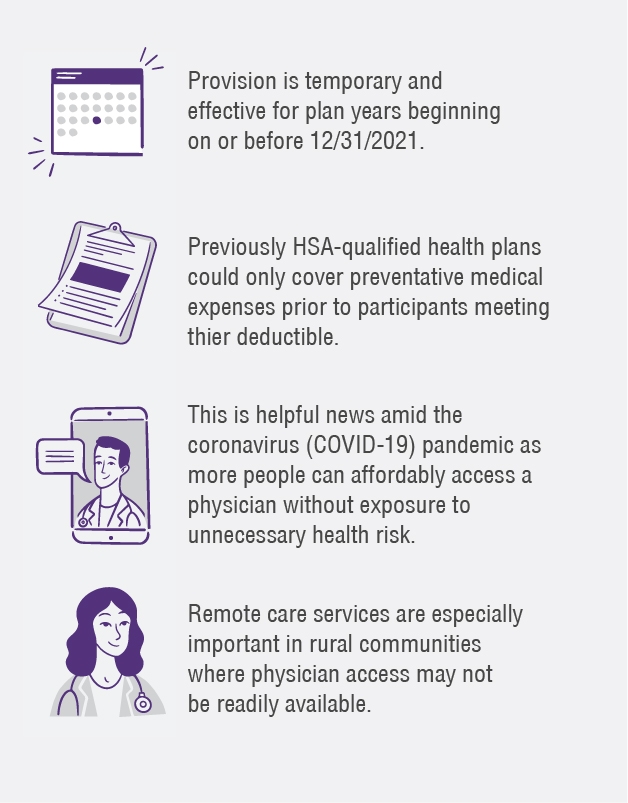
The telemedicine safe-harbor provision was temporary, applying to plan years beginning on or before December 31, 2021, with some plans potentially covered through late 2022.
Congress passed the Coronavirus Aid, Relief and Economic Security Act (the "CARES Act"), a $2 trillion stimulus bill to aid the recovery from COVID-19. Included in the bill is language that created a temporary safe-harbor for Health Savings Account-compatible health plans covering telemedicine.
Remote care services allow patients to see doctors without ever having to leave their homes.
Here's what changed:
-
Before the CARES Act: If an HSA-qualified health plan covered telemedicine before a member met their deductible, that member couldn't contribute to an HSA.
-
With the CARES Act safe harbor: HSA-qualified health plans can cover telemedicine at any time, and members can still contribute to their HSAs.
Why does this change matter for your employees and your benefits strategy?
Before this change, if a plan covered telemedicine pre-deductible, it could disqualify an individual from contributing to an HSA.
Telemedicine helps people get care with less friction, and Deloitte research makes this clear:
- 64% of patients point to convenience and access as important benefits of telemedicine
- 57% of those who have not used telemedicine are willing to try it in the future
- For physicians, the top three benefits are:
- Improved patient access to care (66%)
- Improved patient satisfaction (52%)
- Staying connected with patients and their caregivers (45%)
That's not all. A survey by the American Journal of Managed Care found "62.6% of patients and 59% of clinicians reported no difference in 'the overall quality of the visit' and 'a majority (52.5%) of clinicians reported higher efficiency of a virtual video visit."
Telemedicine is becoming more a part of the healthcare system, and those with HSAs are now able to participate without losing the ability to contribute to their HSA. For benefits administrators, this creates a practical opportunity: you can support easier access to care while protecting HSA contribution eligibility, which can strengthen both employee experience and long-term financial wellness.
What do the changes mean for employee benefits leaders?
Employees can treat telemedicine as a more accessible front door to care, especially when employees may face barriers like staying at home during public health events or living in rural areas with fewer local providers. To turn the safe harbor into a smoother experience for employees, focus on a few clear actions:
-
Confirm plan design details with your carrier or administrator. Ask whether telemedicine visits get covered pre-deductible under the safe harbor, and how claims get coded.
-
Update employee communications. Make it simple: "You can use covered telemedicine and still contribute to your HSA," then spell out where to find telemedicine access instructions.
-
Coordinate with your HSA partner. Ensure your teams align on eligibility messaging, so employees don't get mixed signals.
-
Document what you share and when. Clear records help you stay ready for questions and audits.
How long did the telemedicine safe harbor last, and why should you double-check timing?
While telemedicine is an important part of the future of healthcare, it is also important today, especially as millions of people must remain at home due to COVID-19. The new safe-harbor in the CARES Act mean more people can use telemedicine services and not risk exposure to unnecessary health risks.
In addition, those members with HSAs who live in rural areas where doctors and hospital may not be as plentiful can now utilize plan-covered telemedicine without losing the ability to contribute more funds to their HSA. However, the telemedicine provision is temporary and effective for plan years beginning on or before December 31, 2021. So, these new telemedicine rules could apply to some plans through late 2022.
Nevertheless, the new safe-harbor in the CARES Act is a huge win for the many Americans with HSAs who want to use remote care services. HealthEquity is excited to help them explore the possibilities.
For more information on how the CARES Act impacts HealthEquity Members, click here.
For more information on how the CARES Act impacts HealthEquity Employers, click here.
Frequently asked questions
References and disclosures
HealthEquity does not provide legal, tax, financial, or medical advice.