
Key takeaways
-
The right starting point for Artificial Intelligence (AI) in benefits administration depends on your team’s unique needs, evaluated across four factors: need, value, viability, and availability.
-
Benefits leaders have identified four high-impact AI opportunities: health plan recommendations, AI-powered self-service, automated claims processing, and plan design modeling.
-
Evaluating AI ideas against five key questions, including time savings, affordability impact, and employee experience, helps you prioritize confidently and act strategically.
Editor’s note: This blog post is a direct follow-up to episode 1 of Benefits Innovation Lab. If you haven’t checked it out yet, be sure to register to view or listen on demand and download the accompanying free handout to get the most out of this article.
Deciding where to start with Artificial Intelligence (AI) in benefits administration can be a difficult task, and we hope Benefits Innovation Lab from HealthEquity has been helpful as you’ve gotten your journey underway.
How can benefits leaders choose what to do first with AI?
Our first episode of the series covered how to decide which employee benefits problems to solve with AI. And if you gave it a watch or a listen, you received our free downloadable chart to help you think about many of those issues further. Now, let’s dive a little deeper.
In this blog, we’ll cover four potential ideas for AI use among benefits teams, identified by working benefits professionals in a 2024 HealthEquity survey. We’ll talk about each opportunity and the considerations you might make while you’re weighing them against each other, and against other ideas you may have.
Let’s get started by talking about how to gather potential ideas in the first place.
What AI priorities should benefits leaders choose?
This blog—and the accompanying downloadable PDF—evaluates four areas of opportunity benefits leaders identified as the most promising for AI use. But that doesn’t mean they’re the only areas you may be considering.
The best place to start with AI will always depend on the particularities of your team and organization, and you may wish to start by evaluating your team’s processes and flagging potential areas of opportunity.
Generally, you can identify the best ideas by evaluating them across four areas of consideration:
-
Need. Start by asking if the opportunity would advance your organization’s business objectives or contribute directly to your unique value proposition or long-term strategy.
-
Value. Estimate the amount of benefit AI would add to the activity by thinking through the relative time and monetary cost, as well as its impact to more qualitative areas like business insight and employee experience.
-
Viability. AI thrives when activities are low-risk, quantifiable, and repeatable. Ask yourself if your team has the data and risk appetite necessary to bring in an AI tool.
-
Availability. AI is still a developing technology, so any opportunities you identify should have an existing tool available in the marketplace—as well as the organizational budget to support it.
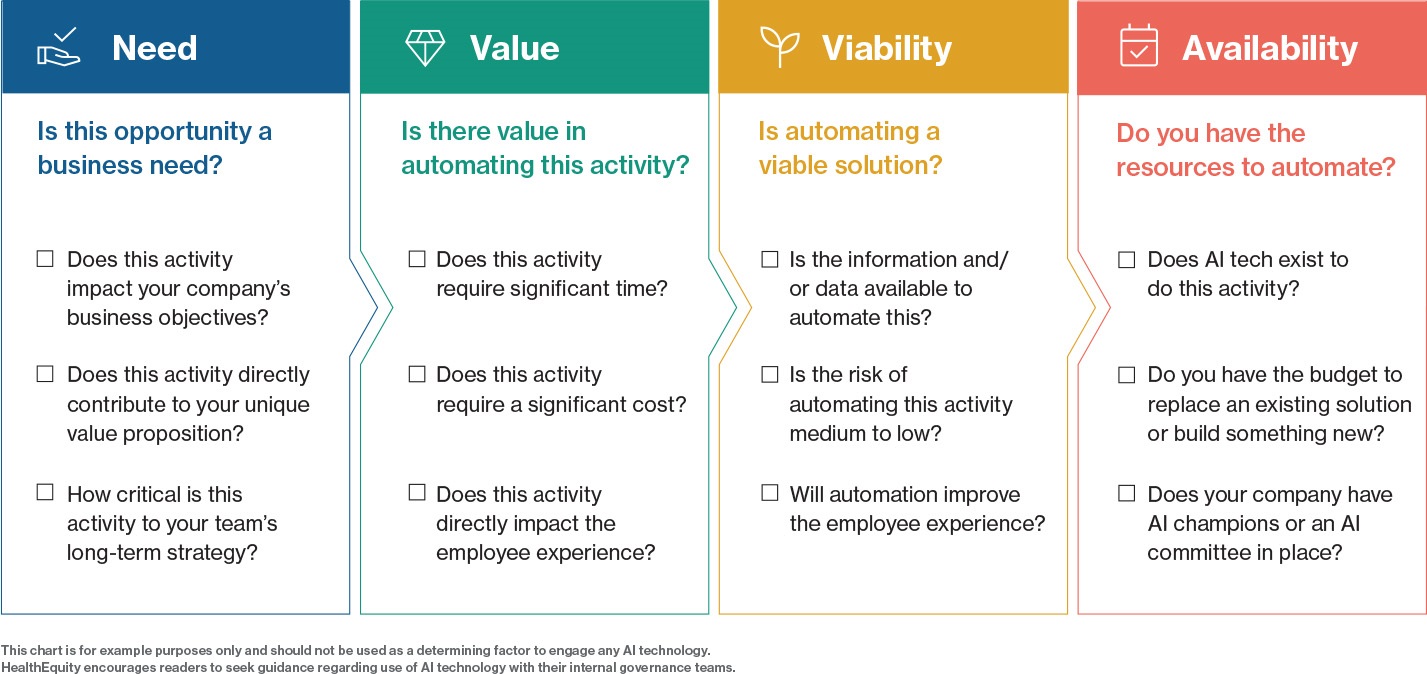
Once you’ve made a shortlist of opportunities, you’re ready to start weighing them against each other.
What questions should you ask when evaluating AI?
There are many ways to evaluate the potential value of using AI to handle a benefits administration process. The most important factors will depend on your individual organization, but five good questions to start with are:
| Question to ask | What you’ll reveal |
|---|---|
| How much time will it save your benefits team? | Whether this removes repetitive work that doesn’t require a human touch |
| How much time will it save the employees you serve? | Whether it reduces friction while still meeting employee needs |
| What important organizational insights will it provide? | Whether it improves benchmarking, surfaces gaps, or clarifies needs across demographics |
| How will it impact healthcare affordability? | Whether it can help reduce out-of-pocket costs or improve plan strategy |
| How will it affect the overall employee benefits experience? | Whether it improves outcomes and perceptions, both quantitatively and qualitatively |
Now, let’s examine the four top areas identified by benefits leaders according to these areas.
1. Could AI help employees pick the right health plan?
Choosing a health plan is an important event most full-time employees must do at least once a year, and it’s often daunting. According to a 2024 survey from HealthEquity:
- More than a quarter (26%) of employees say picking a plan makes them stressed.
- 13% say they aren’t confident they chose a plan that best suits their needs.
Perhaps that’s why benefits leaders identified health plan recommendation as a top AI opportunity at their organization.
Employers can’t and shouldn’t give advice on which plans employees choose, but they do spend time educating employees on how their options compare. Employees then spend time deliberating, often with their families, before making a final choice. AI could hasten this process by analyzing employee health information and personal priorities to recommend a plan best suited to the employee’s needs. That could drive several downstream benefits:
- Save time for employees, families, and your benefits team during open enrollment.
- Increase confidence by reducing stress and uncertainty around plan selection.
- Support affordability by highlighting low-cost options like a high-deductible health plan (HDHP) paired with a Health Savings Account (HSA).
- Strengthen insight into employee priorities by analyzing AI-assisted plan choices.
2. Could AI-powered self-service reduce common benefits questions?
Employee service questions are another source of time cost for both benefits teams and employees. While some questions require human insight and empathy, many queries are simple and easily answered by AI tools like chatbots.
Using AI-powered service options also reflects employee preference. A 2024 survey from Tidio revealed that 67% of customers prefer using a form of self-serve over talking to a customer service representative.¹
Automating self-service with AI could free up time for both your benefits team and your employees, while empowering your people to clear up obstacles standing in the way of better benefits outcomes. AI self-service matches consumer preference, providing a better overall experience, and an occasional perusal through the queries the tool receives will give you invaluable insight into overall employee benefits literacy at your organization.
3. Could AI streamline claims processing?
AI is also primed to automate claims processing by auto-completing claims data with receipt photographs and alerting employees to any errors or missing information. This would create a smoother experience for employees, who often must go back and forth to provide data they didn’t know was missing while waiting several days to learn if their claim was approved or denied.
Claims denial is a painful experience for both employees and benefits teams, and your benefits team members may have to spend time educating employees on how to navigate the process more effectively while providing context on a specific claims decision.
Adding AI tools therefore addresses many points of potential value, it frees time from both employees and benefits teams, it provides comprehensive data about the most common sticking points for employees, and it dramatically improves employee experience with an important aspect of their benefits. Also, more claims being approved more quickly translates to more funds returning to employee pockets.
All of these factors play a large role in determining benefits outcomes.
4. Could AI help you analyze and model plan design changes?
One of your benefits team’s most important duties is to choose and design plans that best support your employee population. This involves large-scale data analysis and modeling practices, activities that AI performs very well. With the right AI tool, your team can analyze your current offerings as well as model any potential plan changes.
You can gauge the performance of these plans according to several metrics:
- Employee demographics
- Benefits performance gaps
- Employee preferences
- Affordability inequities
Using AI tools in this way saves a massive amount of time for benefits teams, while highlighting how your organization can make more efficient use of your budget. And better-designed plans often mean greater affordability for employes, which could lead to better benefits outcomes, higher morale, and a higher retention rate across the company.
Implementing AI for employee benefits
When it comes to implementing AI, your benefits team can start almost anywhere. But by evaluating your own organizational priorities and the likely outcomes of an AI solution, you can feel confident that you’ve chosen a starting point that will yield the kind of results you prize most.
Looking for an example of a benefits-focused AI chatbot? Check out HSAnswers from HealthEquity.
Frequently asked questions
References and disclosures
HealthEquity does not provide legal, tax or financial advice.
¹ Tidio, 2024: https://www.tidio.com/blog/self-service-statistics/.