
Key takeaways:
- Year-round education, not just open enrollment blitzes, helps employees absorb and retain benefits information when they need it most.
- AI tools and digital resources can answer employee questions on demand, reducing the burden on HR teams while meeting the expectations of younger workers.
- Personalizing benefits communication by life stage and generation helps ensure the right message reaches the right employee at the right time.
Financial stress doesn’t stop when an employee badges into the office. It follows them to their desk, sits in on meetings, and—perhaps most critically—impacts their ability to focus. Lost productivity due to financial stress is estimated to cost employers $40 billion each year.¹
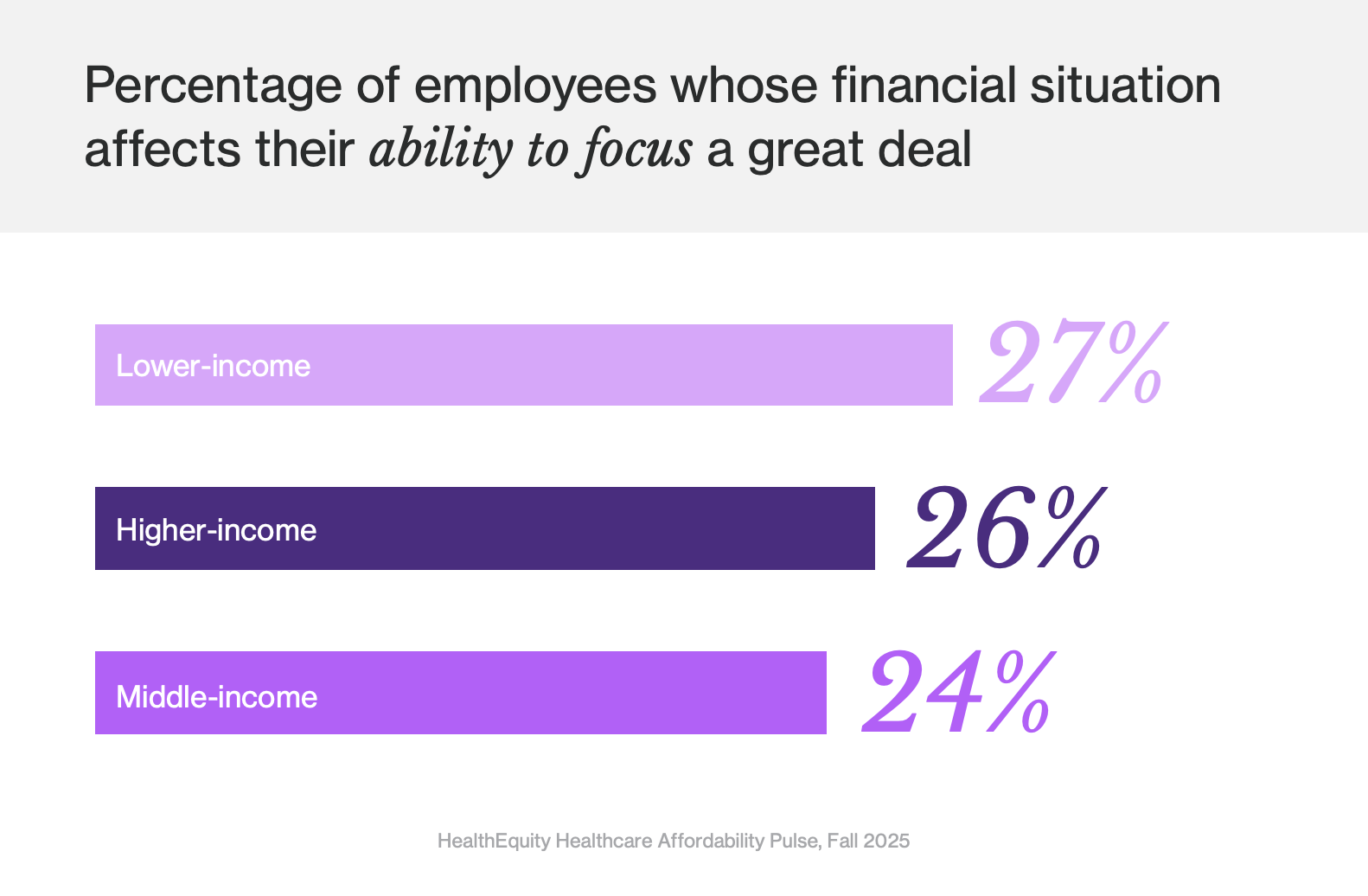
HealthEquity’s Healthcare Affordability Pulse revealed a stark reality. Approximately 1 out of 4 survey respondents shared that their financial stress was affecting their ability to focus at work, and this held true across all income levels.²
While benefits leaders can’t necessarily impact the broader economic trends, they do hold a powerful tool to make a difference for employees: benefits literacy.
What is benefits literacy?
Benefits literacy is an employee’s ability to understand, choose, and use their benefits with confidence.³ Employees with a high level of benefits literacy will:
- Grasp the key differences between your health plan options.
- Know how to enroll in your programs.
- Navigate benefits decisions with ease.
Benefits education is how benefits teams build this literacy in their employee populations. They prepare educational materials, hold benefits webinars, answer employee questions, and guide decision making. Ideally, benefits education is happening all year round, not just in a concentrated blitz during open enrollment or for new hires.
How does benefits literacy impact employee focus and productivity?
Benefits literacy can directly support focus by reducing “money stress” that shows up in the middle of the workday. HealthEquity’s Healthcare Affordability Pulse found that employees who understood their benefits “very” or “extremely” well were 45% more likely to say financial stress does not affect their work focus.
A few insights can help you plan smarter education:
- Gen Z and Millennials report higher understanding (53% and 62%).
- Gen X and Boomers report lower understanding (both 47%).
- Health Savings Account (HAS) holders are 46% more likely to understand their benefits than non-HSA holders.
That’s a clear signal: when people know how preventive care works, how a high-deductible health plan (HDHP) functions, or how an HSA can help them plan for out-of-pocket costs, they often feel more in control. Control drives confidence, and confidence supports productivity.
How can I build a culture of benefits literacy?
Knowing that benefits literacy can help reduce financial stress at work is one thing; achieving it is another. Fortunately, you don’t need to overhaul your entire benefits education strategy to see results.
Here are three practical ways to enhance understanding right now.
1. Move beyond open enrollment.
Information overload during open enrollment is real. If that is the only time employees hear about their benefits, they may forget the details by January.
The Fix: Shift to a year-round education strategy. Break complex topics into bite-sized pieces delivered monthly or quarterly.
- Example: Dedicate April to promoting financial benefits like HSAs, HPAs, or 401ks during Financial Literacy Month.
- Example: Use tax season to highlight the triple-tax advantage of an HSA.⁴
- Example: Tap HealthEquity’s Content Library for insightful, timely member education.
Continual opportunities for learning may help employees absorb information at their own pace.
2. Leverage AI and digital tools.
You don’t have to answer every question manually. As a piece by HealthEquity CEO Scott Cutler noted, younger employees are particularly likely to want on-the-spot answers, and AI is perfectly suited to meet this need.
The Fix: Utilize AI tools for on-demand question support or preparing benefits education materials.
- Example: Tools like HealthEquity’s HSAnswers leverage artificial intelligence to provide instant, conversational support for benefits questions.⁵
- Example: Use generative AI tools like Claude or ChatGTP to create benefits one-pagers, blog posts, or other content (with careful checks for accuracy).
3. Personalize the experience.
A recent college graduate likely has different financial concerns, questions, and goals than an employee nearing retirement. Your communication strategy should reflect that. Use data to segment your audience and tailor your messaging.
The Fix: Use data to segment your audience and tailor your messaging.
- For younger generations: Send information about student loan repayment assistance or budget-friendly Lifestyle Spending Accounts (LSAs).
- For older employees: Target this cohort with information about catch-up contributions, retirement savings, and long-term care.
By investing in benefits literacy, benefits leaders do more than explain the nitty-gritty details of deductibles, commuter benefits, or HSA contributions. You give your employees the clarity they need to navigate their financial lives with confidence, be more productive, and feel more focused at work.
Frequently asked questions
References and disclosures
HealthEquity does not provide legal, tax, or financial advice.
¹ HealthEquity, Healthcare Affordability Pulse Fall 2025.
² Financial Post, “Workers are stressing out over their finances — and it’s costing employers billions,” 2022.
³ Allianz, “Employee Benefits Education: Driving Benefits Literacy for Successful Programmes,” 2025.
⁴ HSAs are never taxed at a federal income tax level when used appropriately for qualified medical expenses. Also, most states recognize HSA funds as tax-deductible with very few exceptions. Please consult a tax advisor regarding your state’s specific rules.
⁵ HSAnswers is an AI language model that is intended to provide general information, not professional or personalized advice. AI generated responses are not guaranteed to be accurate. By messaging HSAnswers, you agree to our Terms and have read our Privacy Policy.