
Key takeaways
-
A Health Savings Account (HSA) contribution match, similar to a 401(k) match, drives significantly higher employee participation and savings than a seed-only approach.
-
Incentivizing HSA plans with an employer contribution match is a win for both employers and employees.
-
Combining an HSA-qualified plan with a structured contribution match helps employers cut costs, boost engagement, and support employees’ long-term health and financial wellbeing.
As the healthcare cost scene keeps shifting, employers and benefits professionals are looking for creative ways to tackle rising expenses while still providing a top-notch benefits package.
Healthcare benefits play an important role in ensuring employees’ health and financial wellbeing. They’re also a bit of a puzzle for employers who are trying to strike a balance between offering a competitive benefits lineup and keeping costs in check.
What are some common employee benefits contribution strategies?
One solution that has gained popularity is pairing a high-deductible health plan with a Health Savings Account (HSA), not just as a tax-advantaged saving tool for employees, but also as a clever way for employers to trim premium costs without sacrificing quality.¹ In particular, adding an HSA contribution match is a great way to motivate employees to save more and reduce their overall healthcare expenses by paying with tax-free HSA funds.
What’s driving benefits costs higher right now?
Every year, the premiums increase for employer-sponsored health coverage. This year, they even surpassed the typical inflation rates.
-
Premiums rose sharply year over year: In 2023, the average premium for family health coverage increased seven percent from the year before, far higher than the one percent increase from 2021 to 2022.
-
Premium growth outpaced key benchmarks: Premium increases exceeded workers’ wage growth (5.2%) and overall inflation (5.8%).
-
Prescription costs create added pressure: Specialty drugs continue to drive healthcare spending, and many employers are looking to control prescription costs when designing benefits.
Why consider an HSA contribution match to cut benefits costs?
There are many reasons for employers to tackle rising healthcare benefits costs. A competitive benefits package can make a big difference in employee job satisfaction and retention. Employees who are satisfied with their benefits are more likely to stick around, which is a huge win in today’s tight labor market. And research shows that when it comes to benefits, the majority of employees say they want better, more affordable healthcare.
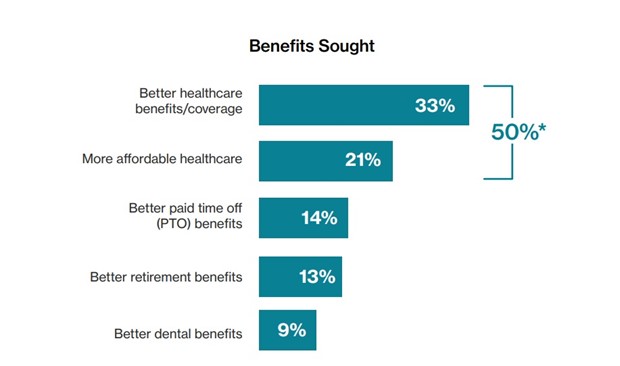
Plus, when employees have access to useful benefits and wellness programs, they’re more likely to take positive steps for better health and financial security.
What’s more, employers are also looking for benefits that work well for all their employees and don’t cost a fortune. That’s where benefits plan design comes in handy.
How can smarter plan design help you rein in costs?
When it comes to battling healthcare costs, one of the most effective strategies is smart health plan design. Plans like HDHPs paired with HSAs are one way to hand more control to employees while also cutting costs for employers.
In 2022, HSA plan premiums were about 11% lower than traditional PPO plans.² Plus, HSA plan premiums tend to go up less each year, only 5.7% from 2022 to 2023, compared to 7.7% for PPO plans.
HSAs may help employees make savvy choices about:
-
Healthcare spending
-
Prescription medications
-
Preventive care
-
Wellness activities
But here’s the trick: simply offering an HSA-qualified plan isn’t enough. Employers find that adding a well-thought-out HSA contribution match program boosts employee engagement, encourages plan use, and increases savings.
Instead of employees treating an HSA like a savings account (albeit a tax-advantaged one), it becomes a tool that employees are motivated to use. And when more employees contribute to and use their HSA, that benefits both the employer and the employee.
What’s the difference between an HSA seed and an HSA match?
A seed means you contribute to an employee’s HSA regardless of what they contribute, often as a lump sum, periodic deposits, or a combination. A match means you contribute only when the employee contributes, based on your matching formula. Many employers seed HSAs to help employees transition, but then shift to a match structure to sustain participation.
How can “seed then match” improve adoption without blowing up your budget?
When implementing an HSA contribution plan, it’s helpful to structure the program in a way that is not only cost-effective but also encourages adoption. You can make seed contributions in several ways, such as:
-
A lump sum
-
Smaller amounts throughout the year
-
A combination of both tactics
To boost adoption, consider offering an HSA-qualified plan with lower premiums than your regular plan. This way, the choices cost about the same. For instance, you could offer a PPO plan with a $400 monthly premium or an HSA-qualified plan with a $200 monthly premium and an extra $200 monthly employer seed.
It’s not uncommon for organizations to seed the first year of an employee’s HSA to help them transition into the plan, but few make the important switch to a match system to continue encouraging contributions. According to HealthEquity research, only 12% of employers provide a contribution match compared to 68% who offer a seed.
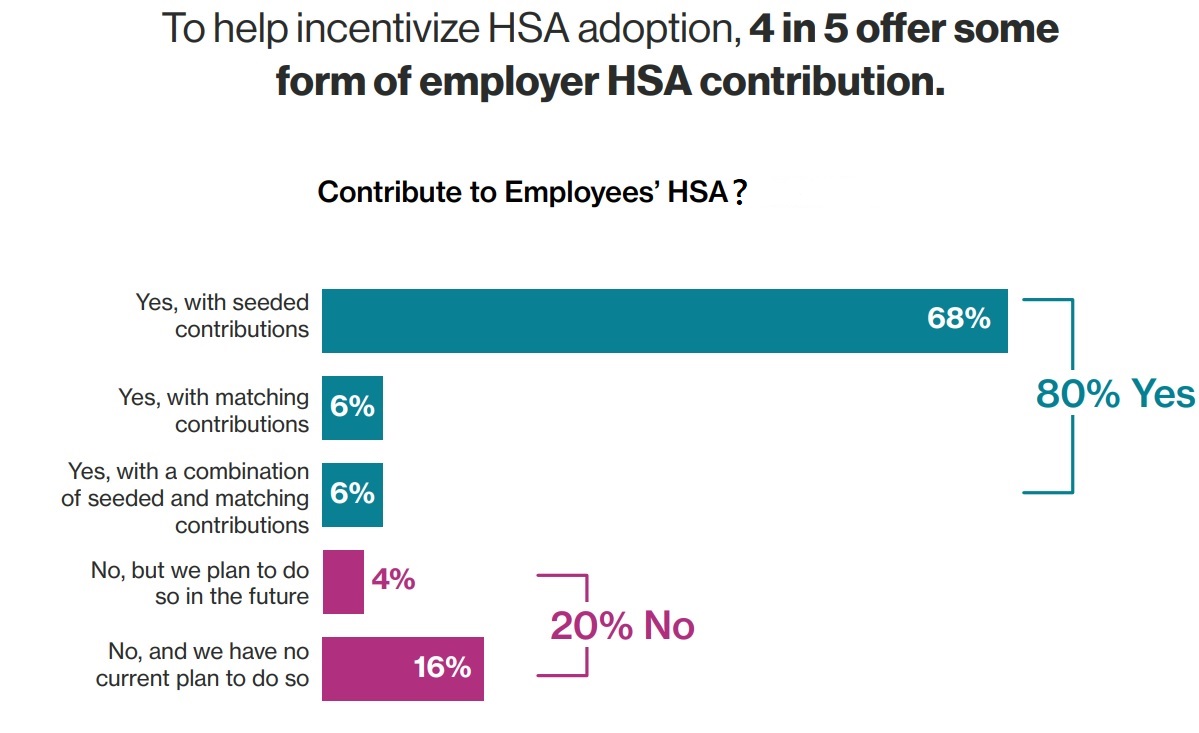
A smart contribution plan is not just a great cost-cutting strategy, it can also help employees build a financial safety net.
What results can you expect from an HSA contribution match?
Let’s take a look at two similarly-sized organizations in the hospitality industry in the HealthEquity book of business who offered their employees an HSA, one providing a seed and the other a contribution match of roughly the same amount.
Employees who got a matching contribution not only showed a higher likelihood of putting money into their HSA, but they also contributed significantly more compared to those who only received a seed.³
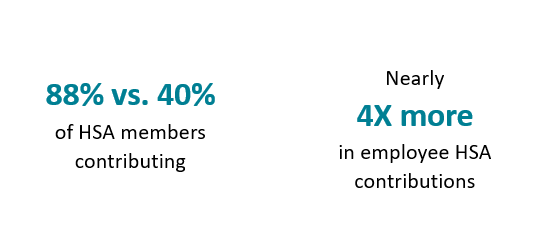
Notably, the match approach also saved the organization money, with the employer contributing 42% less compared to the seed-only employer. And because the contribution match encouraged employees to add extra funds to their HSA, they had 24% higher HSA balances than those only getting a seed contribution. The additional HSA funds allow employees to build a safety net for unexpected medical expenses and start investing for their future healthcare needs.
Elevating HSA plans with an employer contribution match is a win for all. It motivates employees to contribute to their HSA, while the employer sees a positive impact on their bottom line.
How do you put an HSA match strategy into practice?
For HSA contribution matches to work well, employers need to integrate them smoothly into their benefits package.
-
Align the match with your benefits strategy: Tie it to your affordability goals, retention strategy, and total rewards message.
-
Make the match easy to understand: Spell out the match formula, limits, timing, and how employees trigger the match.
-
Build year-round education: Reinforce how HSAs work, what qualified medical expenses include, and how preventive care coverage works under the plan.
-
Support employees across income levels: Position the match as a tool that helps employees start saving, even if they can only contribute small amounts initially.
-
Measure and adjust: Track participation, employee contribution rates, HSA funds, and employer contribution spend, then refine your match thresholds or communications.
Making a difference with cost-effective health benefits strategies
In a world where healthcare costs keep rising, you need strategies that work but don’t hurt your bottom line. The HSA contribution match is more than a financial perk, it’s a reflection of an employer’s dedication to their employees’ health and financial wellbeing.
By combining the power of an HSA-qualified plan with a contribution match, you have the potential to cut costs, boost employee participation, and create a benefit program that truly stands out. It’s a step toward a more cost-effective future for healthcare benefits, and one that can set your organization apart in a crowded field.
Frequently asked questions
References and disclosures
HealthEquity does not provide legal, tax, or financial advice.
¹ HSAs are never taxed at a federal income tax level when used appropriately for qualified medical expenses. Also, most states recognize HSA funds as tax-deductible with very few exceptions. Please consult a tax advisor regarding your state’s specific rules.
² Kaiser Family Foundation, 2023 Employee Benefits Survey.
³ HealthEquity data, current as of February 2024.