
Key takeaways
-
Artificial Intelligence (AI) won’t replace benefits professionals. These tools can handle repetitive tasks, like claims processing and plan recommendations, so your team can focus on higher-value, strategic work.
-
With diverse training data, regular audits, and transparent algorithms, AI can actually help you build more equitable benefits programs.
-
The more benefits leaders understand AI, the more confident they become: 92% of those who feel knowledgeable about AI believe it will positively impact benefits administration.¹
Employee benefits leaders are cautiously optimistic about the promise of artificial intelligence (AI). According to a HealthEquity survey,¹ more than 70% of benefits leaders believe AI will have a positive impact on benefits administration.
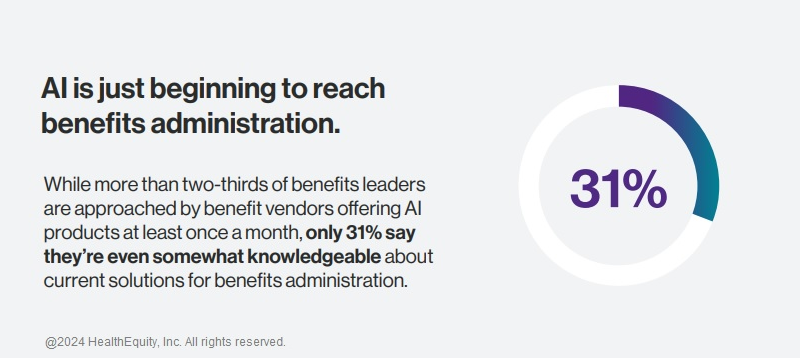
But there is still a high degree of uncertainty surrounding these technologies. Just 31% of survey respondents agree they’re even somewhat knowledgeable about current AI solutions, and many have concerns about how AI will influence their jobs and the lives of the employees they serve.
As some unknowns remain, the truth is that many AI-related concerns have answers that can mitigate worry and boost confidence among benefits professionals. In this post, we’ll share four common myths around AI in benefits administration and the reality behind them.
Myth 1: Does benefits administration really have much to gain from AI?
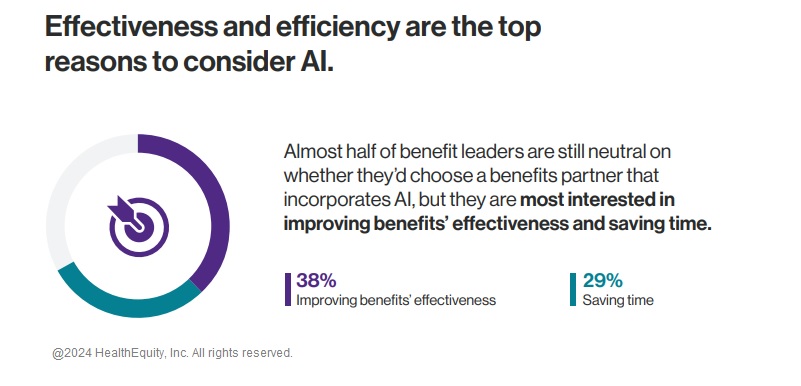
Most benefits leaders are at least somewhat optimistic about the impact AI will have on their jobs, but some have reservations. A little over 25% of survey respondents said they either had no opinion or a negative opinion on AI in benefits administration. Similarly, almost half (46%) said they were neither likely nor unlikely to choose a benefits partner that incorporates AI.
When asked why, these benefits leaders pointed to unfamiliarity with what AI could accomplish. Without knowing what benefits administration stands to gain from AI, AI is a low priority or even an unwanted element in the office.
The truth is that AI presents many opportunities to augment the work of benefits professionals. There are many areas where AI can automate tasks, analyze data, and streamline processes to allow benefits teams more time and greater insights that will improve benefits programs.
Some of the top ways AI can help are:
- Recommending health plans to employees: An AI tool can help improve employee outcomes by taking in information from employees and analyzing it to recommend health plans best suited to their needs. As roughly half of employees spend less than an hour² choosing their health plan, citing lack of time and too many choices, having the assistance of an AI tool could help people feel more confident they’re making the right decision. And with plans chosen based on employee-provided data, both financial and medical outcomes may improve.
- Providing employee self-service: Another way AI can help improve the employee experience is by providing self-service for many common questions and services. The right AI tool can serve across multiple channels to answer queries and perform simple services, helping people resolve issues on their own time. This service can also support benefits teams as they review aggregate data on common problems and identify where they can improve employee education or onboarding.
- Improving claims efficiency: Streamlining claims was one of the most popular potential features of an AI-powered benefits tool, according to the HealthEquity survey. With AI, employees could snap a photo of their receipt for eligible medical goods and services, upload it to their benefits platform, and let AI auto-fill data and alert them to any potential errors or missing information.
- Modeling optimal plan design: When it comes to AI, benefits teams can have access to deep insights on plan performance. Benefits professionals can analyze individual plans across multiple employee demographics to help ensure plans are as effective as possible. They can also model potential plan outcomes as benefits teams consider updates to plan design or even entirely new benefits. With these capabilities, teams can make informed decisions about how they evolve their benefits programs over time.
These are just a handful of the capabilities an AI-informed benefits team wields. Understanding this, it’s not surprising that benefits leaders who say they know the most about AI are the most interested in implementing it at their organizations.
In fact, 92% of those who strongly agree they’re knowledgeable about AI believe it will have a positive impact on benefits administration. Just 57% of those who strongly disagree they’re knowledgeable about AI say the same.
Myth 2: Is AI going to take my job?
Across all industries and job levels, working professionals wonder about how AI will impact their employment. One of the top questions that emerged in the HealthEquity survey was whether AI will replace or eliminate human roles of brokers and benefits managers.
It’s a natural question, but AI is much more likely to function as a job enhancer rather than a job eliminator.
As we explored in our last post on AI, the best benefits teams exert a human touch—one that is compassionate, empathetic, and able to provide personalized support in sensitive situations. Benefits professionals can weigh important factors outside of data. They place insights from AI in context with organizational goals, employee morale, and ethical considerations to make nuanced decisions that align with a broader purpose.
While AI will augment tasks like those described in our first myth, benefits teams will have more time and insights to reach for innovative solutions in creating effective, responsive benefits programs.
It is the unique combination of human skills, values, and judgment that ultimately drives the success of benefits programs and fosters a positive employee experience,” says Shuki Licht, VP Head of Innovation at HealthEquity. “Integrating AI with human expertise can harness the strengths of both, to optimize benefits management outcomes.
Myth 3: Are AI algorithms biased, and could that create inequitable outcomes?
Nearly 80% of U.S. workers³ say it’s important that their employers make diversity and inclusion a priority in the workplace. Creating a culture and practice of diversity, equity, and inclusion (DEI) is an organization-wide effort that reaches across all departments, and it has particular importance in employee benefits.
Successful benefits teams administer plans and programs that deliver results across all employee demographics. Understandably, some benefits teams are concerned about how AI may exhibit bias in its algorithms.
One in ten benefits leaders surveyed by HealthEquity expressed concerns over algorithmic bias in AI. If present, algorithmic bias creates systematic and unfair outcomes due to the unintentional incorporation of prejudices or stereotypes present in the data used to train them. This can result in discrimination or inequitable treatment of certain groups based on race, gender, age, socioeconomic status, or other factors.
In other words, if the benefits data used to train AI tools doesn’t adequately represent the employee population, AI could end up perpetuating bias rather than eliminating it.
Much can be done to promote fair AI system algorithms. Benefits leaders should work with their technology teams to ensure the following.
| What to check | What it helps you do |
|---|---|
| Collect diverse, representative organizational data | Reduce the chance AI outcomes skew toward overrepresented groups |
| Audit AI training data for bias | Catch hidden patterns that could lead to unfair outcomes |
| Require transparent, explainable algorithms | Understand how recommendations happen, and support defensible decisions |
| Build diverse implementation teams | Bring more perspectives into design, testing, and rollout |
| Monitor AI regularly for bias | Spot drift early and correct issues before they impact employees |
These standards are also important to keep in mind when evaluating potential benefits systems that incorporate AI.
When implemented correctly, AI can not only avoid bias, but it can also help benefits teams create and administer more equitable programs at an organizational level. Data analysis with AI can reveal how different benefits are performing across certain employee populations. Analyzing outcomes among employees based on characteristics like age, race, or income level allows benefits teams to uncover any inequities and address them. They can even do this preventatively by modeling prospective changes to plans to ensure equitable effects across different demographics.
Myth 4: Would AI be too difficult to implement in my organization?
All technological innovation involves change management, and AI is no different. In the HealthEquity survey, some benefits leaders expressed concern over implementation issues like regulatory compliance (8% cited this as their biggest concern with AI), cost and return on investment (8%), and challenging workflow changes (2%).
But these requirements are manageable with the right preparation and planning.
Checking off these boxes should bolster confidence within the organization:
- Network with peers and early adopters to learn what worked, and what didn’t.
- Align internally across security, technology, and finance, so everyone supports the plan.
- Consider an AI committee to guide decisions, reduce risk, and build buy-in.
- Ask vendors about implementation support and real examples from past clients.
This approach helps you manage change while preparing for the greater gains that can come from implementing AI.
How can you build confidence around AI in benefits administration?
Much of the uncertainty around AI—and the prevalence of these myths—is due to lack of familiarity with the technology.
As benefits leaders learn more about AI, their confidence grows and they find meaningful ways to mitigate their concerns.
Your team can do the same. Learn more about AI in benefits administration by reviewing more of the HealthEquity survey findings and reading about how AI will change the way benefits teams work.
Frequently asked questions
References and disclosures
HealthEquity does not provide legal, tax or financial advice.
¹ HealthEquity survey, “Top benefits leaders see opportunities and concerns in AI.”
² Employee Benefit Research Institute. (2023). Consumer Engagement in Health Care Survey. Retrieved from: https://www.ebri.org/docs/default-source/cehcs/2023-cehcs-report.pdf
³ Penn LPS Online. (2023). DEI in the workplace: Why it’s important for company culture. Retrieved from: https://lpsonline.sas.upenn.edu/features/dei-workplace-why-its-important-company-culture.